
 Available in GB
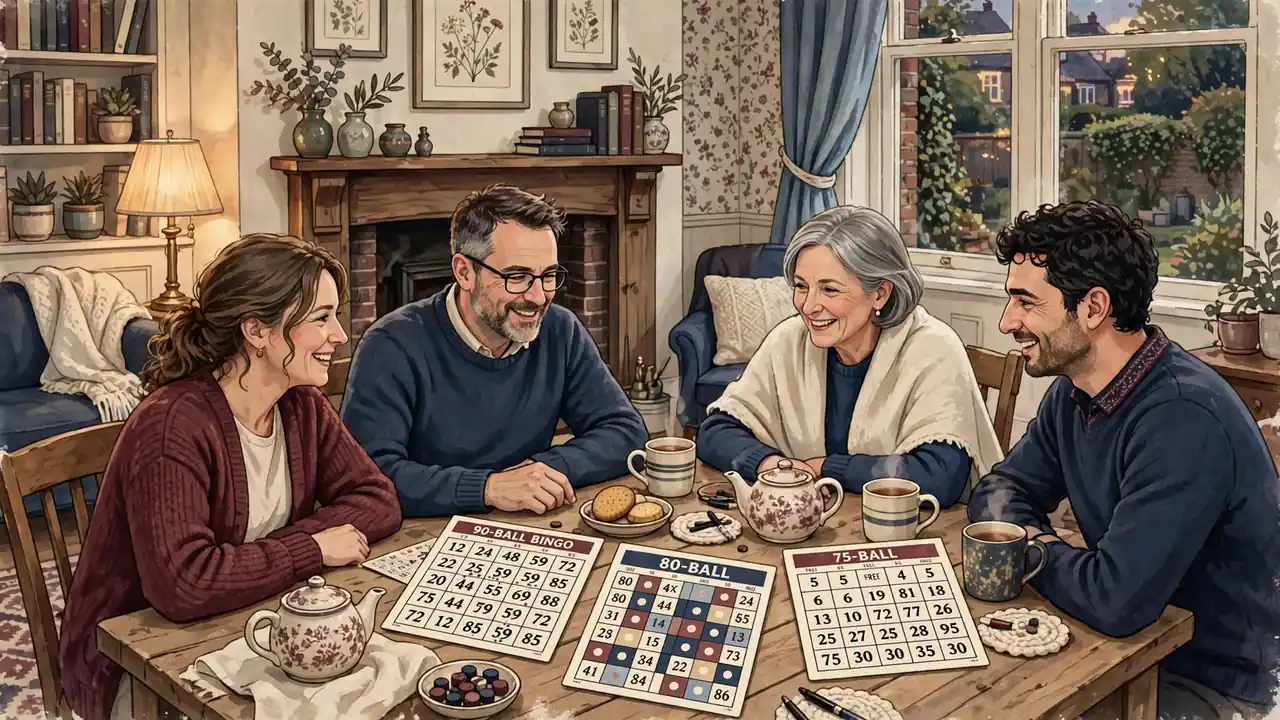
Ticket layouts shape how rounds are won, while room features, slot access and bonus conditions affect how bingo sites work.
Bingo formats are distinguished by the layout printed on a ticket and the pattern needed to win. The familiar 90-ball game uses a rectangular ticket arranged in three rows and nine columns. Prizes are awarded as players complete one line, then two lines, with a full house as the final pattern. The sequence gives the round several possible winning stages rather than a single card-completion target.
The label 80-ball bingo can refer to more than one grid layout. One version uses an eight-by-four grid, with coloured patterns determining the target. These may include four corners, a letter shape or the full card. Another 80-ball format uses a four-by-four grid and has quicker rounds than 90-ball bingo. The two layouts should not be treated as interchangeable: both are described as 80-ball games, but their ticket shapes and pace differ. A room’s format description is therefore relevant to understanding what a ticket requires.
In 75-ball bingo, the ticket is a five-by-five grid. Rather than progressing through line prizes as in 90-ball bingo, a win depends on completing a specified pattern. Targets can include a cross, an X, a diamond, the letter T or a picture frame. The pattern gives the round its objective, so the same grid can support different winning conditions.
Monopoly Live Casino UK: Evidence and Checks
These distinctions matter when comparing game names. “Ball” identifies the format, but it does not alone explain the ticket’s shape or how a prize is determined. A 90-ball ticket is defined by its 9×3 layout and staged line wins; 80-ball games may use either an 8×4 or 4×4 grid; and 75-ball games use a 5×5 card with pattern-based wins. Checking both the grid and the stated target makes the rules clearer before play begins.
An online site may present bingo and casino games within one account or on the same website, but the shared setting does not make them the same product. In a bingo room, players buy tickets, numbers are drawn, and a win depends on completing a pattern before other players. Casino games operate under their own rules and determine results through their individual game formats. The distinction matters when interpreting labels such as “online casino bingo”: the phrase may describe bingo offered by a casino operator, or a site that places bingo alongside casino products, rather than a single hybrid game.
Online American Roulette Casinos in the UK
The familiar bingo-room structure remains recognisable online. Players take part in a draw using tickets, and the result is tied to the pattern required by that game. A casino product offered on the same platform has a different ruleset and outcome process. Their proximity is therefore a matter of how the operator groups its entertainment, not evidence that the games share the same mechanics or regulatory status.
“Bingo casino” can also be an imprecise description of a site’s range. It may refer to a bingo-led service with casino products available as an additional category, or to a casino-led service that also provides bingo. The title of a section, menu or promotional page is not enough to establish what is available or how a particular game works. The relevant information is the operator’s description of the product, its rules and the licence held for the activity.
Online bingo is legal in the United Kingdom, but it is subject to regulation. An operator that offers bingo to UK players must hold the appropriate UK Gambling Commission (UKGC) licence; a general claim that a site is a “casino” or “bingo club” does not substitute for that authorisation. Where a business offers more than one form of gambling, the relevant licensing requirements apply to the activities it provides. A licence for one product should not be taken as proof that every other product on the same site is covered.
The licensing framework addresses standards including fairness, anti-money laundering and responsible gambling. These requirements concern the operator’s conduct and the conditions under which gambling is offered. They do not make bingo and casino games interchangeable, nor do they imply that every outcome is favourable to a player. A regulated service remains a gambling product, with outcomes and potential losses inherent in participation.
Licensing
An operator must hold the appropriate UK Gambling Commission (UKGC) licence; a general claim that a site is a "casino" or "bingo club" does not substitute for that authorisation.
This context is relevant whether the site is described as an online bingo casino, a casino with bingo games, or a bingo service with casino options. Those labels explain the way a business presents its range; they do not establish the legal basis on their own. The central question is whether the operator holds the UKGC licence required for the gambling it offers to people in the market. A site’s branding, app design or shared account interface cannot replace that legal requirement.
For recreational players in the United Kingdom, winnings from online bingo are not taxable. This concerns the player’s winnings; it should not be confused with the operator’s licensing obligations or with the rules governing the products on a site. The tax treatment also does not convert gambling into a source of assured income. Bingo remains a game in which participation involves uncertainty, and a result in one session does not establish what will happen in another.
Where bingo and casino games appear together, the distinction is therefore practical as well as regulatory. The bingo room retains its ticket-and-draw structure, while casino products follow their own rules. The operator must be authorised for the activities it offers, and recreational bingo winnings are not taxable in the UK. These points clarify what the shared “bingo and casino” label does—and does not—say, without treating the products as one game or implying that the same description answers every question about a site.
Online casinos without ID in the UK: what to know
The cost of a bingo ticket is the clearest starting point for comparing games, but a low ticket price does not by itself describe the possible prize or the chance of winning. Online rooms include low-stakes options priced from 1p to 5p, while premium games can charge £1 or more for a ticket. Other descriptions place penny-room tickets at 2p and high-stakes games at £5 or above. These are different ways of describing price bands, not a single fixed tariff applying across every room.
The amount at stake depends on how many tickets are bought and their individual price. A ticket costing a few pence represents a different outlay from one priced in pounds; buying more than one multiplies that ticket cost. This calculation concerns the money committed to play, not the likelihood of a return. Ticket prices and prize structures need to be considered separately, since a higher entry cost does not establish that a particular player will win more.
Prize examples illustrate the possible contrast between games, but they should not be treated as standard offers. A specialist review gives the illustration of a 1p game with a £10 full-house prize, compared with a £1 game that could carry a jackpot in the hundreds or thousands of pounds. The review’s examples are time-sensitive and do not establish a market-wide relationship between ticket price and prize value. A prize may also depend on the rules and conditions of the particular game, so the headline amount alone is not enough to assess the value of a ticket.
A ticket purchase is a definite cost, whereas a prize remains uncertain, and higher entry costs do not establish that a player will win more.
A lower ticket price can make an individual entry less expensive, while a premium game may involve a larger cost per ticket and advertise a larger potential prize. Neither comparison establishes expected winnings. A large jackpot is a possible outcome, not an amount that can be assumed to accrue to each participant, and the stated prize examples do not show how often such prizes are won. The distinction matters in real-money online bingo: the ticket purchase is a definite cost, whereas a prize remains uncertain.
Before comparing rooms, it is therefore useful to identify the price of each ticket and the prize attached to the relevant game. Where several tickets are purchased, the total entry cost should be calculated from the displayed ticket price and quantity. A room label such as “low stakes” or “high stakes” is less precise than the actual price shown for the game. Similarly, a prize headline should be read as a potential award rather than as a likely return or a measure of value.
A low-cost game may still list a substantial prize, and a premium ticket may carry a larger advertised jackpot, but those examples do not make either outcome predictable. The practical comparison is between the amount paid to enter and the stated prize conditions, with no assumption that the higher-priced option is more rewarding.
A site that presents bingo and slots together is offering distinct forms of play in one setting. The bingo room remains centred on tickets, number draws and the completion of a winning pattern. A slot game, by contrast, is a separate side game. Their presence under the same site or account does not make them one game, nor does it mean that taking part in bingo automatically includes slot play.
The combination can nevertheless link the products. A specialist review has reported that some bingo rooms have offered a free slot spin for each bingo ticket bought. That is a specific kind of cross-product offer, not evidence that every room provides it or that the terms remain unchanged. It also should not be read as changing the nature of the ticket: the ticket is for bingo, while the spin belongs to a slot game.
Online Casino Tournaments in the UK: Rules and Claims
This distinction matters when interpreting descriptions of online bingo and slots. A page may group both under one heading, but the games can have separate rules and outcomes. A bingo result depends on the draw and the pattern being completed; a slot result is generated within the slot game. Taking part in one does not establish a result in the other. Any link between them needs to be stated explicitly, rather than inferred from their appearing side by side.
The term “side game” also describes a relationship of placement, not a guarantee that the slot is minor in financial significance. Slots may be presented alongside a bingo room, but their return-to-player percentages can be lower than those of the bingo room itself. RTP is a measure used to describe a game’s theoretical return over play, not a prediction of what an individual session will return. A lower figure therefore does not tell a player what will happen in a particular spin, and a higher figure would not guarantee a positive outcome either.
The comparison should be kept within its limits. Bingo and slots operate differently, so an RTP figure for a slot should not be treated as a direct measure of the quality of a bingo room. Nor does the fact that a slot is offered as a companion product make its potential return equivalent to the bingo game’s prize structure. The figures relate to different forms of play and should be considered in the context of each game’s own terms.
For the same reason, “bingo casino slots” can describe a collection of products rather than a single category with uniform rules. A room may place bingo games and casino-style games in the same account environment, while keeping their play mechanics distinct. Where a slot spin is linked to a ticket purchase, the connection is the offer itself; it does not turn slot play into a bingo feature or make the spin’s result part of the bingo draw.
Online European Roulette Casinos in the UK
The practical point is that co-location should not be mistaken for equivalence. A bingo room and its accompanying slots can be encountered through one platform, but each remains a separate product with its own way of producing results. The presence of slots does not establish that every bingo room has them, and the existence of a ticket-linked spin does not establish a general pattern across operators. Such a claim is best treated as an offer reported in a particular review, rather than as a standard feature of UK bingo rooms.
When a site describes bingo and slots together, the description is therefore most useful when it makes the relationship clear: whether the products are simply available alongside one another or whether a stated offer connects them. That distinction helps prevent the presence of casino games from being confused with the bingo game itself. It also keeps attention on the relevant difference in return measures: side games may have lower RTPs than the bingo room, but neither that comparison nor the shared setting predicts an individual result.
A site offering both bingo and slots should be assessed as a gambling operator, not simply as a collection of games. The central question is whether it is authorised to serve the British market and whether its account safeguards, identity checks and complaint arrangements meet the relevant requirements. A polished presentation or a broad choice of games cannot substitute for those checks.
An operator serving UK players must hold a separate UK Gambling Commission (UKGC) licence. Before depositing, the licence number should be checked against the UKGC public register. It should also be displayed prominently in the site footer; if it is not, the tab should be closed immediately. A licence reference shown on a promotional page is not, by itself, a substitute for checking the number on the public register. The key point is that the licensed operator must be the business actually providing the gambling service.
Assessing an Operator
UKGC-licensed operators must verify players’ identities, and age checks must be completed before a customer is allowed to deposit. The process commonly involves providing photo identification and proof of address. These checks are part of the account relationship, not an optional feature associated with one product. A site may offer bingo and slots under the same account, but that does not remove the operator’s responsibility to verify who is using it.
The age requirement is 18+. A credible assessment therefore includes looking at how the operator handles registration and verification, rather than relying on an age statement on a landing page. If the account is shared across product areas, the same verified identity should underpin access to them. The relevant standard applies to the operator, whether a game is reached from a bingo lobby or a casino menu.
Remote gambling operators must prompt new customers to set a financial limit before their first deposit and provide accessible account-level controls for setting limits. These controls should be considered as part of the account’s core safeguards, not as a promotional extra. Deposit limits may be set for a day, week or month, although the precise options and presentation can differ between operators. Their purpose is to give the account holder a way to restrict deposits over a chosen period.
Online Casino Games for Real Cash in the UK
Payment rules also matter when assessing an operator. Credit card gambling is banned in the UK. Operators cannot accept credit-card payments for gambling, including credit-card funding routed through a money service business. They also cannot accept wallet payments where that wallet allows credit-card funds to be used for gambling. The restriction is not avoided by moving the payment through an intermediary.
These checks are relevant on mobile as well as on a larger screen. A small display does not change the licensing, identity or payment rules. The account should still provide access to financial-limit controls, and payment methods should still comply with the ban. A mobile layout may place account information in a menu, but the legal obligations remain attached to the operator and the gambling account, not to the device.
A UKGC licensee must provide an internal complaints process and access to an approved Alternative Dispute Resolution (ADR) service. The complaints route should be identifiable in the site’s help or account information, with the distinction between contacting the operator first and escalating a dispute to an approved ADR service made clear. A general customer-service contact route is not the same as a stated formal complaints process.
UKGC-licensed casinos must also provide responsible-gambling tools, including self-exclusion. These protections are relevant where bingo and slots sit within one account: the account-level safeguards should not be treated as applying only to one part of the service. The presence of a tool is meaningful only if its function and access route are clear enough to identify within the account.
Payment Restrictions
Attention: Credit card gambling is banned in the UK, including funding routed through a money service business or wallets that allow credit-card funds for gambling.
On a phone or tablet, the same assessment can be made without assuming that an operator has a particular app or mobile feature. The licence number, complaints information and account controls remain the relevant checks. If the site is being viewed in a mobile browser, the footer and account menus can be inspected; if information is difficult to locate, that difficulty should not be mistaken for proof that a required safeguard is absent. The licence number, however, must be prominently displayed in the footer, and its absence is a reason to close the tab.
There is no sound basis for calling a site the best solely because it combines bingo and slots, appears recently launched, or is presented well on mobile. A defensible comparison starts with verifiable regulatory status and then considers whether identity checks, account-level limits, complaint procedures and self-exclusion are in place and accessible. These are standards for evaluating an operator, rather than claims about a particular brand.
For newer services, the same tests apply as for established ones. A recent launch does not remove the requirement for a separate UKGC licence, age and identity verification, compliant payments or accessible limit controls. Nor does a mobile-friendly appearance establish that those protections are adequate. The useful distinction is between presentation and safeguards: the former may vary by site and device, while the latter are obligations of the operator.
A concise assessment therefore focuses on the licensed business behind the service, the licence number’s status on the UKGC register, the timing of age verification, the identity process, the availability of account limits, and the stated complaints and ADR routes. For a bingo-and-slots account, these checks apply across the service rather than only to the product first opened. On mobile, they remain the same checks, not a separate standard.
Live Casino Lightning Roulette in the UK
“Free play” can describe different arrangements, so the wording alone does not establish that bingo tickets, slot games or both are available at no cost. One specialist review describes a narrower offer: a free slot spin is awarded for each bingo ticket purchased. In that arrangement, the spin is linked to spending on bingo; it is not evidence of a general free-play facility or of free bingo tickets.
The distinction matters when assessing claims about free online bingo slot games. A free spin attached to a ticket purchase is a specific promotion, not a catalogue of slots available to play without payment. Nor does it establish that the same offer is currently available across bingo rooms. The description is tied to a reported arrangement, rather than a general feature of online bingo.
The same care applies to references to free online bingo slot machines. The reported offer concerns a slot spin, but the phrase does not establish that a physical-style machine, a collection of games, or a separate no-cost mode is available. It also does not show whether the spin can be used on any slot or only on a specified game. Those details cannot be inferred from the basic description.
A free spin should also be distinguished from the underlying return of the game. Side games often have lower return-to-player percentages than the bingo room itself. RTP is a measure of the share of stakes a game is designed to return over extended play; it does not predict the result of a single spin. A free spin therefore does not, by itself, make the side game equivalent to bingo or establish its expected value.
The practical meaning of an offer depends on its terms: whether a bingo ticket must be bought, what the spin applies to, and how any resulting winnings are treated. Those conditions should not be assumed from the words “free spin”. The reported ticket-linked arrangement establishes a possible connection between bingo purchases and slot play, but not a general entitlement to free games.
Mines Casino Game in the UK: What Is Verified
Accordingly, claims about free play are best read narrowly. A described spin linked to a purchased ticket is not the same as free bingo, unrestricted access to slot machines, or a broad library of games at no cost. The distinction keeps the promotional wording separate from what the arrangement actually describes.
A bingo-themed slot is still a slot game, not a bingo round: its outcomes come from the slot’s play rather than from completing a bingo ticket pattern. That distinction matters because British online slot rules apply to the machine-style game, even when it appears on a site whose main product is bingo.
Autoplay is prohibited for online slots in Britain. Each spin must also last at least 2.5 seconds, so a game cannot offer faster spins or let the player set a sequence of spins to run automatically. These rules apply to online slot play, including slots presented within a bingo-site interface.
Stake limits depend on age. For customers aged 25 and over, the maximum stake is £5 per game cycle; for customers aged 18 to 24, it is £2. The limits concern the stake on each slot cycle, not the price of a bingo ticket. Gambling is restricted to adults aged 18 or over, and an operator must verify a customer’s age before permitting deposits.
Real-money slots offered to customers in England, Scotland and Wales fall within the UK Gambling Commission’s licensing framework. Remote gambling operators serving the British market must hold the relevant UKGC licence, wherever the operator is based. A bingo label or themed presentation does not exempt a slot from these requirements.
The rules are relevant when assessing what an online bingo slot machine offers: the game should not provide autoplay, its spins must meet the minimum duration, and its stake ceiling must reflect the player’s age group. These are regulatory limits, not indicators of a game’s likely return or of whether a particular slot is suitable. No particular game’s features or payout can be inferred from the fact that it is available alongside bingo.
Plinko Casino UK: Availability, Licensing and Demos
It is possible for an online bingo room to be linked to slot play, but that does not mean every bingo site offers the same arrangement. A specialist review describes a promotion in which a player receives a free slot spin for each bingo ticket purchased. This is a specific crossover offer: the ticket purchase is connected to a spin on a slot game.
That example answers the basic question, but it should not be taken as evidence that slot games are available at every bingo site, or that a free spin gives access to a broader selection of slots. The reported offer concerns a particular kind of promotion, not a general rule about bingo rooms. Availability depends on the product being offered.
It is also useful to distinguish a free spin linked to a ticket from ordinary paid slot play. The former is tied to a bingo purchase; it does not, by itself, establish that a site offers slots for separate cash wagers. Nor does the existence of the promotion show how many games are available or whether the spin can be used at any time. Those details depend on the individual offer.
The clearest conclusion is therefore limited: bingo and slot products can be connected, and a reported example links a free slot spin to each bingo ticket bought. That demonstrates one way the products may be combined, rather than establishing a standard feature across online bingo sites. A bingo room remains identifiable by its ticket-based game, while the linked spin is a separate slot activity. The two can appear in the same offer without becoming the same game.
Accordingly, a bingo site may provide a route to slot play, but the presence of bingo alone does not confirm that it does. The reported ticket-linked spin is evidence of a crossover product, not proof of universal slot availability.
Keno Casinos in the UK: Draws, Payouts and Checks
A bonus headline does not establish whether an offer is genuinely available without a deposit, or what must happen before winnings can be withdrawn. The term “no-deposit” describes how an offer is accessed; its eligibility rules, permitted games and withdrawal conditions still depend on the terms attached to it. A bingo-and-slots offer may combine cash, tickets or spins, but each component can be governed by different rules.
One specialist review describes a new-player package containing a £10 cash bonus and 30 free bingo tickets. That is a reported offer, not a reliable guide to what every operator provides. The important distinction is whether a bonus is credited as cash or remains promotional credit, and whether play on bingo, slots or both counts towards its wagering requirement.
A specialist review reports deposit-based bingo offers with wagering requirements from 20x to 65x, with some applying the multiple only to bonus funds. It also reports cash-bonus requirements from 30x to 40x before withdrawal. These figures describe reported terms, not a fixed market standard. The offer’s wording should specify which balance is multiplied, which games qualify and whether winnings from free tickets are treated separately.
The calculation can materially affect the amount of play required. A specialist review gives the example of a £40 bingo bonus with a 4x requirement: £160 in eligible ticket spending is needed before withdrawal. A displayed balance therefore does not necessarily represent cash that can be withdrawn immediately.
Expiry rules matter as well. A specialist review reports that a 30-day wagering period may begin when the bonus is credited. Separate review material describes free tickets expiring within 24 to 72 hours, sometimes with restrictions to particular rooms or ball types. These conditions can make an offer unusable if eligible games are not available before the deadline. Free-ticket winnings may also carry the same wagering requirement as a deposit bonus; the ticket itself cannot be withdrawn as cash.
Before accepting an offer, the relevant terms are the qualifying deposit, eligible games, wagering basis, expiry point and withdrawal conditions. Those details determine the practical value of a promotion more than its advertised headline amount.
Yes, some offers include free bingo tickets, which let you enter eligible games without buying those tickets. They may be limited to particular rooms or ball formats and can expire after 24 to 72 hours.
90-ball bingo uses a 9×3 ticket, with prizes for completing one line, two lines and then a full house. 75-ball bingo uses a 5×5 card, and the winning target is a pattern such as a cross, X or diamond.
Try playing outside the 7pm–11pm peak period, when rooms schedule their largest prize pools.
Published by the goldwincasin team.